
Protecting Escape Routes Under BS9999
BS9999 sets out that ductwork running through escape routes must be fire resisting wherever there's a heightened fire risk, or wherever the ducting crosses a protected escape route.
Where a duct crosses an escape corridor, it needs to match the Stability, Integrity, and Insulation rating of whatever barrier it's passing through — the ductwork can't be the weak link in that barrier.
Halving Your Fire Damper Requirement
If either side of the escape corridor is built using standard, non fire-rated duct, the installation needs two fire dampers to maintain compliance. Specify Firetrace's non-coated fire resisting ductwork instead, supplied under the Caswell Firesafe® system, and that requirement drops to just one damper.
Fewer dampers means a lower bill across the board: less to buy, less to install, less to test and maintain on an ongoing basis, and less to eventually replace down the line.
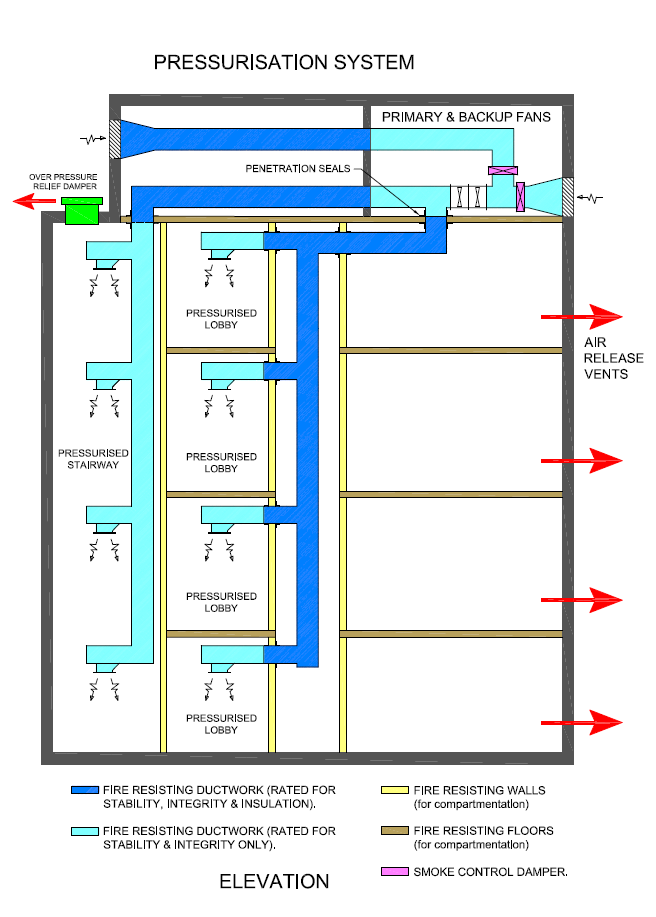
Escape route pressurisation — elevation diagram
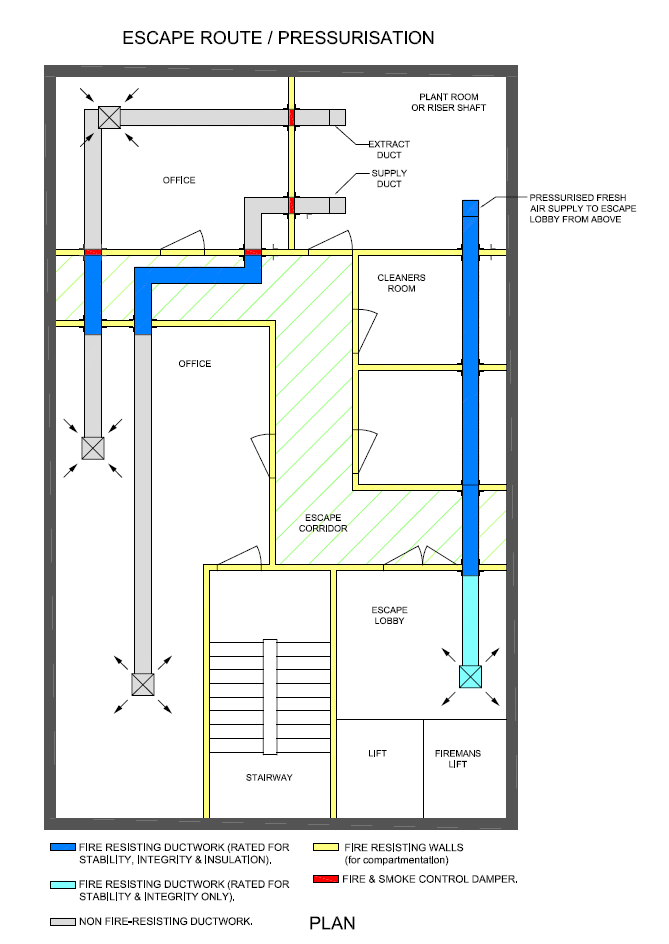
Escape route pressurisation — plan diagram